
Restaurant chains are falling into two camps: those that are expanding and those that are contracting. On one end, growth-driven brands like Culver's, Texas Roadhouse, and Nothing Bundt Cakes are opening hundreds of new locations; on the other, legacy heavyweights including Wendy's, Papa John's, Denny's, and Pizza Hut are closing locations. While inflation, changing tastes and private equity shifts can be major factors, SOCi's Local Visibility Index (LVI) data suggests there's a correlation between restaurant footprint and local digital presence.
SOCi.ai compared eight expanding restaurant brands against eight contracting ones and found that growing restaurant chains averaged an overall visibility score of 62 out of 100 while contracting brands averaged just 47. The gap appeared across every major area of local discovery—including artificial intelligence, search, reputation, and social.

SOCi.ai
The AI Recommendation Gap
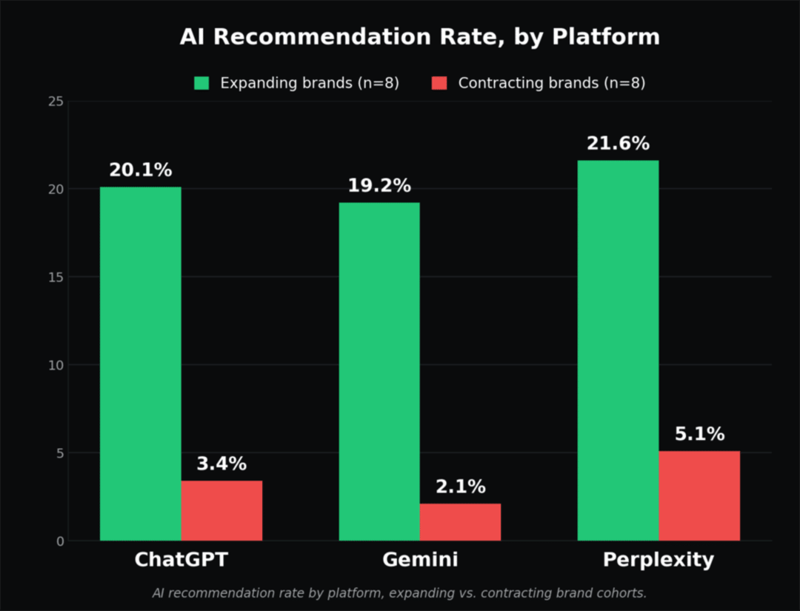
With 37% of consumers starting searches with AI, visibility in AI searching experiences is becoming increasingly important. The LVI data shows expanding chains are recommended by ChatGPT in about 20% of tested queries, compared to roughly 3% for contracting chains, a nearly sevenfold gap. Similar patterns emerged with Gemini and Perplexity and expanding brands carry meaningfully higher AI-assigned sentiment scores across all three AI tools.
SOCi.ai
AI recommendations, however, are difficult to earn. According to LVI, only about 1% to 11% of brand locations get recommended across ChatGPT, Gemini, and Perplexity, compared to 35.9% appearing in the traditional Google 3-Pack.
As AI often relies on signals such as trusted third-party content, online discussions, and a brand's broader digital presence when generating recommendations, brands with stronger local visibility may be more likely to surface in AI results. Expanding restaurant brands are showing up more in places AI prioritizes, which may help explain their higher recommendation rates.
Search and Reputation Tell the Same Story
AI recommendations are only one piece of the local discovery puzzle. With 16.4 billion searches on Google every day, consumers still rely heavily on traditional search. Brands that are easier to find in local search and maintain stronger online reputations also appear to be the ones gaining ground in physical expansion.
- Search visibility: Expanding chains appeared in Google's local 3-Pack for 35.3% of tracked searches versus 14.4% for contracting chains, and held Yelp's top organic spot nearly twice as often (55% vs. 29.3%).
- Reputation: Expanding brands average a 4.39 Google rating and a 3.65 Yelp rating, compared to 3.82 and 2.49 for contracting brands, more than a full star apart on Yelp specifically. Expanding brands also respond to 72.4% of Google reviews (vs. 43.6%) and do so two to three times faster.

SOCi.ai
SOCi.ai
SOCi.ai
Review response is particularly noteworthy because, unlike a star rating built up over years, responding to reviews is a lever marketing teams can pull immediately. The data suggests expanding brands are actively managing local reputation as an ongoing operational strategy instead of passively monitoring reviews.
Growing chains invest in local social media marketing
Expanding brands post content that earns a 3.45% engagement rate with local audiences, roughly 26 times what contracting brands earn (0.13%). Expanding brands also carry about five times the average local follower count.

SOCi.ai
The takeaway isn't "post more," since volume alone doesn't explain this gap. Expanding brands are building real local audiences with content that resonates locally, rather than pushing the same corporate post to every location page. According to SOCI.ai research, 43.3% of multilocation brands employed waterfall posting, the practice of pushing the same corporate post to every location page, at least some of the time. Yet that same research showed local posts from each local social profile generated 71 times more engagement than waterfall postings.
What This Means for Your Brand
Digital visibility alone won't turn around a struggling chain, but for multilocation marketers, the pattern exhibited by brands that are expanding in 2026 is a useful gut check. Successful brands are treating local search, reputation, social, and AI visibility as one connected system rather than four separate to-do lists. Here are a few starting points, drawn from what the data shows expanding brands doing consistently:
- Treat data accuracy as continuous practice, not a one-time cleanup. Consistent business data across Google, Yelp, Facebook, and your own local pages is the foundation for search, reputation, and social engagement—and it's one of the first signals AI platforms evaluate.
- Systematize review response. Create a process for review responses that includes speed and accountability, not just monitoring. This is one of the few levers a team can move in weeks, not years.
- Localize your social content. Expanding brands' five-times-larger followings and 26-times-higher engagement don't come from simply reposting corporate content. These results come from giving local audiences content that is tailored to them.
- Check your AI visibility specifically. High search performance no longer guarantees AI recommendation. If you haven't tested how your brand shows up on ChatGPT, Gemini, and Perplexity, you may be missing an important part of how consumers discover businesses today.
Digital visibility acts as a real-time health check for multilocation brands. Expanding restaurant chains aren't winning because of luck; they treat search accuracy, review responses, local social content, and AI discovery as core to their business.
This story was produced by SOCi.ai and reviewed and distributed by Stacker.